Thursday, April 14, 2016

Nancy Drew and the Clue Crew

Scream for Ice Cream 


Author:  Carolyn Keene                   

Illustrator: Macky Pamintuna 

Date Published: 2008 

About the book: The mystery book written by Carolyn Keene is the second book in the Nancy Drew and the Clue Crew series. The book is written for children between the ages of 6 to 9 years old. 

Summary: Nancy and her friends think there is nothing more fun than ice cream in the summer. So when they find out that the owners of the local ice-cream factory Jim and Barry are hosting a contest, the Clue Crew can't wait to enter! Contestants must come up with brand-new flavors. And they can use whatever ingredients they want! Nancy is sure that her entry - Clue Berry - will win. But when a friend's secret recipe goes missing, Nancy suspects that someone not-so-sweet is up to no good. 

Genre: I consider the genre of this book to be contemporary realistic fiction. "Contemporary realistic fiction is set in modern times with events, settings, and characters that could occur in the real world. Author creates characters, plots, and settings, that stay withing the realm of possibility, and many readers respond to these stories as if the characters were actual people." (Galda, Cullinan, & Sipe. 2010, p.17) Businesses in the food industry have contest all the time. For example, the company that makes Lays Potato Chips is always having contest for new flavors. Therefore, the ice-cream contest is something realistic and modern. The book is also about three friends working together to win the contest and helping a friend to locate a missing recipe. Although the characters and events are all fictitious, these are all acts and behavior that real people do and display. These are the facts upon which I based my decision that this book is a contemporary realistic fiction literature.
  
Illustration:
Page 5  Page 71  Page 33
The illustration of this book seems to be done with graphite, pencils and possibly pens- using varying tones and shades. The technique of the illustration is drawing. This book is a chapter book. Hence, it does not have plenty of illustrations. The style of arts depicts representational art which consist of literal, realistic depiction of characters, objects, and events. Although the illustrations in the body of the book is graphite and pencils, the cover of the book was done with bright, contrasting saturated colors that gives life to the book and beckon to readers. I think this was a wise move on the illustrator's part. The illustration of the book complements the chapters and it's content very well and the illustrator did a wonderful job with the elements of visual arts. 

Motivational Activity:  

Activity 1:                                              We Scream for Ice Cream 
  • After reading the story, teacher and students will use the ice-cream recipe and instruction in the back of the book to make their own favorite flavors of ice-cream. 
Activity 2:                                                   General Discussion


  • After reading the book, teacher and students will have a general discussion about the book. Some questions that will be asked and addressed are; 
  1. What is your personal opinion about the book? 
  2. What is the genre of the book? What evidence/s do you have to support it? (older students) 
  3. Who was your favorite character and why?
  4. What did you not like about the book and why?
  5. What connections can you make with the book?
  6. What do you think about the illustration?
  7. What do you think about the book in general?
  8. What are some text features you noted in the book? 
Personal Opinion: I do like this book although I think that the illustrations could have been more since the book is geared towards readers ages 6 to 9. I love that the book is easy to read and I believe children will find it very interesting as they follow the group of friends on their quest to win the contest and locate the missing recipe. Another feature of the book that made me gravitate towards it was the text features. This book have a table of content, titles and subtitles, and pictures to aid children in reading and understanding. I love that the author included the easy to make ice-cream recipe and instruction that anyone can use- especially teachers in their classroom with limited resources. 

Other books by the Author:

  • The Secret of the Old Clock.
  • The Mystery at Lilac Lane. 
  • The Hidden Staircase. 
  •  Nancy Drew Diaries. 


References: 


Keene, C., & Pamintuan, M. (2008). Nancy Drew and the clue crew: Scream for Ice Cream. Edina, MN: Spotlight.

Galda, L., Cullinan, B. E., & Sipe, L. R. (2010). Literature and the child (7th ed.). Belmont, CA: Wadsworth/Cengage Learning. 

Wednesday, April 13, 2016

A Rain Forest Food Chain 

A WHO-EATS-WHAT Adventure in South America 


Author: Rebecca Hogue Wojahn and Donald Wojahn 

Illustrator: (See section mark Illustration) 

Date Published: 2009 

About the book: This interactive series shows animals in their habitats while illuminating curriculum concepts related to food webs and biomes. The game-like format allows readers to choose a starting animal, then follow a food chain by selecting among options of what each animal could eat.

Summary: As children navigate through the book, they learn about plants, animals, food chain and the South America rain forest. 

Genre: The genre of this book is non-fiction. "Non-fiction books are informational sources that explains a subject." (Galda, Cullinan, & Sipe. 2010, p.18) The book teaches children about animals, the rain forest and the food chain in South America. The format of this book is picturebook. Picturebooks are a format of literature with a unique combination of text and art. (Galda, Cullinan, & Sipe. 2010, p.12) This book has a lot of pictures of animals and plants. 

Illustration: The form of illustration of this book is photographs. These photographs were not taken deliberately for this book but the authors obtained permission to use the photos in their book from the photographers. These photographs are from a collection of about 20+ photographers from the National Geographic, Getty Images, The Image Bank, Minden Pictures, and Visual Unlimited- just to name a few. 

Motivational Activity:                                       Science 

Activity 1:                                          

  • Teacher and students will have a general discussion about the book. Some questions that will be asked and addressed are; 
  1. What is a food chain? 
  2. Where is the rain forest located?
  3. Define and list consumers.
  4. What are the different levels of the food chain?
  5. What are some animals and plants that call the rain forest home? 

Activity 2: 

  • After reading the book, students will create their own food chain using  information stated in the book.

Personal Opinion: I love this book because it is very colorful and informative. "Children are naturally curious about the world they inhabit. They observe and explore, question and hypothesize about how this world works." (Galda, Cullinan, & Sipe. 2010, p.18) I feel this book answers all the possible questions a child might have on this topic. The book is also interactive. Children choose an animal/consumer and follow that animal and its food chain. There are several text features in this book such as pictures and captions, maps, titles and subtitles, bold words, glossary, and index. These all help children to better navigate through the book and learn more. I would definitely recommend this book. 

Other books by the Author: 
  • Dr. Kate 
  • A Coral Reef Food Chain.
  • A Desert Food Chain.
  • An Australian Outback Food Chain 

References: 


Wojahn, R. H., & Wojahn, D. (2009). A rain forest food chain: A who-eats-what adventure in South America. Minneapolis: Lerner Publications.

Galda, L., Cullinan, B. E., & Sipe, L. R. (2010). Literature and the child (7th ed.). Belmont, CA: Wadsworth/Cengage Learning. 

The Legend of Old Befana


Author: Tomie De Paola 

Illustrator: Tomie De Paola 

Date Published: 1980 

About the book: The Legend of Old Befana is an Italian Christmas folklore retold by Tomie De Paola. The celebration of Befana, who flies across the sky on Twelfth Night, leaving cakes and cookies for children as they sleep, is a beloved story in Europe. It is timeworn only by its many versions, and Tomie De Paola's retelling is unique in its resplendent settings and carefully researched detail. His story also broadens the character of the eccentric old recluse of the small Italian village, who is always sweeping. While Befana is sometimes called a witch, Tomie De Paola gives his readers a chance to make their own decisions, imbuing Old Befana with more humanity than most have offered the lonely old woman in her endless search for the Christ Child.

Summary: Old Befana is a lonely old lady that sweeps all day, every day and never lets anyone into her home. One day, while sweeping her walkway, she learned about the child king from three kings in search of him. Later, Old Befana went on her own search. In search of the Christ child, every year on the Feast of the Kings celebrated on January the sixth,  Old Befana visits all the children of Italy and  leaves them homemade candies, cookies, gifts and sweep their rooms clean. 

Genre: The genre of this book is folklore. "Folklore is composed of stories passed down through generations by word of mouth. As such, they have no known author. As people told the stories to one another, they changed and molded them to suit their fancy....Folklore reflects the values of the culture in which it grew; it encompasses universal experiences as shaped by the individual culture." (Galda, Cullinan, & Sipe. 2010, p.15) The Legend of Old Befana has been told for generations and generations in Europe. It has no known author and has been modified many times. 

Illustration:  
Image result for the legend of old befana by tomie depaola story pictures  
The illustration of the book reflects folk art which correlates with the type of literature it is, folklore. The colors are beautiful and complements each other very well.  Tomie De Paola use of lines is spectacular and eclectic, and his use of shape is representational and realistic. The technique of the illustration seems to be drawing and the medium colored pencils and regular pencils. The illustration complements the text wonderfully as they both reflects folklore. Children will find the illustration interesting and captivating as they move from page to page.  


Motivational Activity: 
  • Activity 1 -                  Christmas Around the World
After reading The Legend of Old Befana, teacher and students will compare and contrast the story to other Christmas stories from around the world. 
  • Activity 2 -                          Tomie De Paola Author Study
Using a collection of Tomie De Paola books - including a book Tomie wrote about himself- and the internet, children will complete a research on the life and work about Tomie. They can present the information any way they choose. 

Personal Opinion: I love this book. Although it is a folklore, its a multicultural book that children can learn about another's culture. Children can also relate to this book as it is similar to the famous Santa Clause story. The story is easy to read and beautifully illustrated. Another reason I like this book is because of its religious ties. Most books do not implement religion in its literature so this is a rarity. There is also a ton of activities that can be derive from this book and I would recommend this book to everyone. 

How the Suggested Activities Correlates with Saint Leo University's Core Value of Respect.  

Saint Leo University Core Value of Respect states that "Animated in the spirit of Jesus Christ, we value all individuals' unique talents, respect their dignity, and strive to foster their commitment to excellent in our work.  Our community's strength depends on the unity and diversity of our people on the free exchange of ideas, and on learning, living, and working harmoniously." The activity Christmas Around the World will help students to learn about and respect other people's tradition. It fosters diversity and shows that others are valued. The Author Study activity elaborates on Tomie De Paola's unique talent and his commitment to excellent through his work. 

Other books by the Author: 
  • Nana Upstairs & Nana Downstairs
  • Pancakes for Breakfast
  • The Art Lesson 
  • The Legend of the Bluebonnet 

References: 

DePaola, T. (1980). The legend of Old Befana: An Italian Christmas story. New York: Harcourt Brace Jovanich.

Galda, L., Cullinan, B. E., & Sipe, L. R. (2010). Literature and the child (7th ed.). Belmont, CA: Wadsworth/Cengage Learning. 


Monday, April 11, 2016

A Good Night for Ghosts

Magic Tree House #42 


Author: Mary Pope Osborne 

Illustrator: Sal Murdocca 

Date Published: 2009

About the book: Mary Pope Osborne wrote this book out of her love for Jazz. After living in New Orleans for a few weeks with husband Will, Mary and Will became huge fans of Louis Armstrong and avid collector of his recordings. Mary decided to learn about the life and work of Louis Armstrong which gave birth to this piece of literature. 

Summary: Jack and Annie must travel back in time to New Orleans in 1915 to help a teenaged Louis Armstrong fulfill his destiny and become the "King of Jazz."  

Genre: The genre of this book is Fantasy. Fantasy can be defined as "Imaginative literature distinguished by characters, places, or events that could not happen in real world. Animals can talk, innate objects have feelings, time follows the author's rules, and human accomplish superhuman feat." (Galda, Cullinan, & Sipe. 2010, p.16)  The book revolves around Jack and Annie time traveling to different places and time period via their magic tree house. It also talks about singing, dancing ghosts and magic instruments. These are events that are a figment of Mary's imagination and could never happen in real life. Thus my rational for classifying this book as fantasy. 

Illustration: 
  
The subdued colors of the illustration clearly depicts the time period the children traveled back to. In 1915, everything was, and people only saw things in three colors; black, white, and grey. This was confirmed through my many search on the internet about that time period. The illustrations are very interesting and the scenes, objects, and characters  correlates with the time period. The style of art the illustrator uses seems to be representational art as the illustrations depict  people or objects in a realistic way. The technique of the illustration reflects drawing and the medium seems to be pencils and graphite. There is not much illustrations in the book; For every chapter there is only once illustration. However, these illustration compliments the chapters beautifully and reflects the main idea wonderfully. The illustration on the cover is very colorful and the illustrator did a spectacular job. This presentation will beckon to children and make them gravitate towards the book.  

Motivational Activity: 

Before Reading:                                                 Music 
  • Play a few Louis Armstrong Jazz or any other Jazz music to introduce students to the genre of music. 
  • General discussion about students interpretation of the music, whether they liked it or not, why they did or did not like jazz, and how it made them feel. 
After Reading:                                                Geography

  • Throughout the reading of the story, teacher and students will document all the places they traveled to in the story. 
  • Using Atlases, Maps and Globe, students will then locate these places and record their coordinates next to the name of the place. This will be published in the classroom. 
Personal Opinion: I think this is a great book for children. Although the book is a chapter book, the chapters are not long and drawn out. I like that it is about Jazz as this is a genre of music we no longer hear a lot about. Some children have never heard about Jazz, especially  children of this era. Although the book is a fantasy book, the character Louis Armstrong is a real Jazz musician and through motivational activities and extensions to this book, children can learn a lot. The book is very entertaining and it also stimulates students imagination and senses. I would definitely recommend this book  to everyone. 

Other books by the author: 
  • A Perfect Time for Pandas
  • Soccer on Sunday
  • Stallion by Starlight 
  • High Time for Heroes 

References: 

Osborne, M. P., & Murdocca, S. (2009). A good night for ghosts. New York: Random House.

Galda, L., Cullinan, B. E., & Sipe, L. R. (2010). Literature and the child (7th ed.). Belmont, CA: Wadsworth/Cengage Learning. 

Dark Life 


Author: Kat Falls 

Illustrator: No Illustrator

Date Published: 2010

About the book: A thrilling futuristic adventure set deep undersea, Dark Life follows the settlers of the world's first subsea settlement as they defend their homesteads against a brazen band of outlaws. Kat Falls describes the book as a "underwater western" science fiction novel for upper elementary to middle-grades students. 

Summary: The oceans rose, swallowing the lowlands. Earthquakes shattered the continents, toppling entire regions into the rising water. Now, humans live packed into stack cities. The only ones with any space of their own are those who live on the ocean floor: the Dark Life. Ty has spent his whole life living deep undersea, helping his family farm the ocean floor. But when outlaws attack his homestead, Ty finds himself in a fight to save the only home he has ever known. Joined by Gemma, a girl from the Topside who has come subsea to look for her brother, Ty ventures into the frontier rough underworld and discovers some dark secrets to Dark Life . . . secrets that threaten to destroy everything.

Genre: The genre of this book is Science Fiction. "Science fiction is an imaginative extrapolation of facts and theory: stories project what could happen in the future through a logical extension of established theories and scientific principles."  (Galda, Cullinan, & Sipe. 2010, p.17) This book is about a boy who has powers to communicate with sea creatures and his friend from the land who are working together to fight outlaws and protect the city. The boy's gift is referred to as Dark Gifts- special abilities caused by the water's pressure on their developing brains. It speaks of "underwater colonies" which is not far fetch and the special gifts of their citizens. Plants and animals evolve constantly to adapt to their environment so this is something that could possible happen one day. 

Illustration: This book is a chapter book with no illustrations in it. The only illustration there is, is on the front cover of the book. There is no mention of who illustrated the cover of the book, just the image. However, the illustration does reflect the type of book as it is of a jellyfish on what seem to look like a futuristic background. This illustration adds character to the book and was the main reason I choose this book to be a part of my blog. 

Motivational Activity:

  • Activity #1:                                               Art
After completing reading the book, children can draw a picture of Ty, Gamma, the underwater colonies, or their favorite scene in the book. 

  • Activity #2                                        Language Arts
Students can compare and contrast elements of the book such as the two main characters, Gemma and Ty. Some questions that can help students to complete the task are; How are these two youngsters alike and how are they different? What are their similarities and differences as it relates to their two environments and what are the consequences? Students must provide support for their argument from the text. 

Personal Opinion: Personally, I do like this book. I am not the kind of person who reads science fiction book but this book really capture and holds my attention. I love all the elements of the story such as the characters, plot, theme, settings, etc. It would be nice if the book had a few illustrations at the beginning of each chapter. I believe that this would make it more appealing to people who like to see pictures in the books they read or even to just give a visual of the elements of the story. 

Other books by the Author: 
  • Dark Life Book 2 
  • Inhuman
  • Rip Tide 
  • Undaunted 


References:  

Falls, K. (2010). Dark life. New York: Scholastic Press.

Galda, L., Cullinan, B. E., & Sipe, L. R. (2010). Literature and the child (7th ed.). Belmont, CA: Wadsworth/Cengage Learning.


Saturday, April 2, 2016

Seven Miles To Freedom 

THE ROBERT SMALLS STORY


Author: Janet Halfmann

Illustrator: Duane Smith 

Date Published: 2008 

About the book: Seven Miles to Freedom is the compelling account of the daring escape of Robert Smalls, a slave steamboat wheelman who became one of the Civil War's greatest heroes. His steadfast courage in the face of adversity is an inspiring model for all who attempt to overcome seemingly insurmountable challenges. 

Summary: Growing up a slave in South Carolina, Robert Smalls always dreamed of the moment freedom would be within his grasp. Now that moment was here. Robert stood proudly at the Planter's wheel. Only seven miles of water lay between the ship and the chance of freedom in Union territory. With precision and amazing courage, he navigated past the Confederate forts in the harbor and steered the ship toward the safety of the Union fleet. Just one miscalculation would be deadly, but for Robert, his family, and his crewmates, the risk was worth taking.


Genre: The genre of the book is Biography and the format is picturebook. "Biography tells about a real person's life. The subject of biography are usually people who are famous, such as national leaders, artists, sports figures, writers, or explores, but there are also many biographies and memoir that are about ordinary people who do extraordinary things." (Galda, Cullinan, & Sipe. 2010, p.18) This book speaks about the real life story of Robert Smalls, the events surrounding his escape to freedom and his contribution in the civil war. 
Illustration: 
  
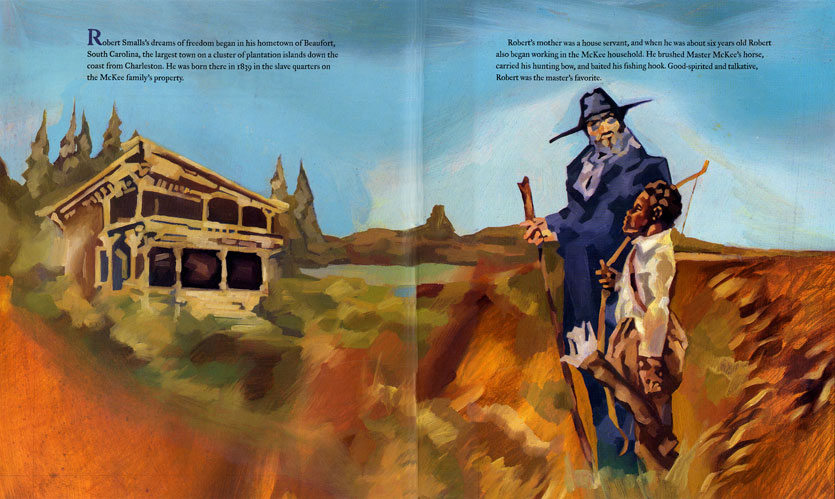
To me, the illustrator has a Combining Style of Art. One style of art the illustrators uses is an abstract, Impressionistic Art style. "Impressionist artists emphasize light and color; they create a fleeting impression of reality." (Galda, Cullinan, & Sipe. 2010, p.83) This style of art reminds me of Ed Young's Lon Po Po. These two style of art are almost identical. The other style of art can be classified as Folk Art. "Folk Art is a broad designation for the style of artistic expression of a particular culture group." (Galda, Cullinan, & Sipe. 2010, p.83) The technique used in creating the illustration is painting and the medium used are acrylic paint and brushes. The illustrator's use of the elements of visual art is immaculate. The lines are not well defined yet they create these astonishing figures. The use of colors that complement each other, the different tint and shades of the many colors, varied lines of different size, length and width, and the way the illustrator uses light to play upon these colors. The texture the brush and paint creates on the canvas is mind-blowing as this adds character to the illustrations. The use of negative and positive space, the variety, the emphasis, and the strategic placement and selection is next to none. This work demonstrates balance and unity. Well done Duane Smith.   


Motivational Activity:                          Black History Month 
  • Activity 1 - Before Reading Questions. 
  1. What is slavery? 
  2. What do you know about slavery in the United States?
  3. What do you know about the Civil War? 
  4. Do you know any famous African American? If yes, Who? Tell us about them.
Readers Response Journal
This will prompt active reading and students must respond to the questions in their journals. 
  1. Who is Robert Smalls and why is he important? 
  2. What was Robert's life like as a slave? 
  3. What stood out to you about Robert Small? 
  4. Why did Robert and Hannah escaped? 
  5. How did Robert prepare for his escape? 
  6. What was Roberts contribution to the Civil War? 
  7. What did he Accomplished after the war? 
  • Activity 2 -                                                Art 
Using the book as their main reference, students must create an artistic representation of Robert Smalls or the Planter. This can be accomplished using several art techniques such as drawing, painting, modeling, collage, computer-generated, and mixed media. This will then be displayed in the classroom. 

Personal Opinion: Personally, I love this book. As a person of African decent, and whose ancestors were kidnapped from Africa and sold into slavery, this book really says a lot to me. It shows me that with strong will, hope, dedication and determination, one can accomplished their heart's desire. This book is good for teaching children about slaves, slavery, and the civil war.  Parents can use it to teach their children what it was like back in the 1800's. I am planning to buy this book for my brother and I would definitively recommend it to everyone.  

Other books by the Author: 
  • Little Black Ant on Park Street. 
  • A Rainbow of Birds.
  • Dolphin's Rescue.
  • Animal Teachers 

References: 

 Halfmann, J., & Smith, D. (2008). Seven miles to freedom: The Robert Smalls story. New York: Lee & Low Books.  

Galda, L., Cullinan, B. E., & Sipe, L. R. (2010). Literature and the child (7th ed.). Belmont, CA: Wadsworth/Cengage Learning. 

The Fantastic Flying Books of Mr. Morris Lessmore


Author: William Joyce

Illustrator: William Joyce & Joe Bluhm 

Date Published: 2012 

About the book: William Joyce has been working on The Fantastic Flying Books of Mr. Morris Lessmore since 1999. The story began as a tribute to the late Bill Morris, the soft-spoken, dry-witted pioneer of library promotions. Then Hurricane Katrina devastated Mr. Joyce's home state and interrupted progress on the book. The author saw firsthand the curative power of stories as he visited displaced children reading donated books in the shelters. Unable to work for a long period of time because of eye surgeries, finishing the book took many paths. 

Summary: Mr. Morris Lessmore loved words. He loved stories. He loved books. But every story has its upsets. Everything in Morris Lessmore's life, including his own story, is scatted to the winds because of a storm. But the power of story will save the day. 

Genre: The genres of this book are fantasy and picturebook. "Fantasy is imaginative literature distinguished by characters, places, or events that could not happen in the real world. Animals can talk, inanimate objects have feelings, time follows the author's rules, and human accomplish superhuman feat (Galda, Cullinan, & Sipe. 2010, p.16) In the book, Morris Lessmore met a lady who was flying with the use of books. She then gave Morris a talking book with legs who took Morris to a place with many talking, flying books. Morris took care of the books and when he got old and crinkly, the books took care of Morris. These are impossible events as books cannot fly, talk, or take care of anyone. "Picturebook is a format in which picture and text are interdependent."  (Galda, Cullinan, & Sipe. 2010, p.16) On every page of the book, there are pictures or illustration. These illustrations are appropriate as they give meaning and clarity to the author's work. 

Illustration: 
   
The illustrations are a combination of subdued and saturated colors. The subdued colors were used to illustrate the disaster that happened in the book and other small illustrations. However, saturated colors are more prevalent in the book. The techniques the illustrators used seems to be drawing and painting.  The illustrations painted a beautiful picture of the story and accompany the text really well. The elements of visual art are identifiable in the illustrators work and are uniquely used.

Motivational Activity: 

  • Activity 1 - Imagine that you are Mr. Morris Lessmore. In your own words, describe what you would do after a bad storm that destroyed and scatted everything in your life. What precautions would you take before the storm? where would you go? what would you do? How do you think people feel when a storm come and destroy their homes? How would you feel?
  • Activity 2 - Imagine that a ‘festive squadron of flying books’ could carry you into the air. Where might they take you? Write a story about the adventure that you would have. 

Personal Opinion: Best sellers and award winning books are very good. It shows that reputable individuals have read and evaluated the book and deemed it worthy of an award in it's category. I like this book because it meets those criteria and some. It is also an academy award winning animated short film. I definitely would recommend this book to others. It teachers the power of books and the love for reading which every child should know and acquire.  I love that the book is easy to read and wonderfully illustrated. 

Other books by the Author: 
  • The Man in the Moon.
  • The Guardian Series 
  • Rolie Polie Olie 
  • The Leaf Men and the Brave Good Bugs 

References: 

Joyce, W., & Bluhm, J. (2012). The fantastic flying books of Mr. Morris Lessmore. New York: Atheneum Books for Young Readers.  

Galda, L., Cullinan, B. E., & Sipe, L. R. (2010). Literature and the child (7th ed.). Belmont, CA: Wadsworth/Cengage Learning.

The Fantastic Flying Books of Morris Lessmore. (2015). Retrieved April 02, 2016, from http://www.teachingideas.co.uk/library/books/the-fantastic-flying-books-of-morris-lessmore